_________________
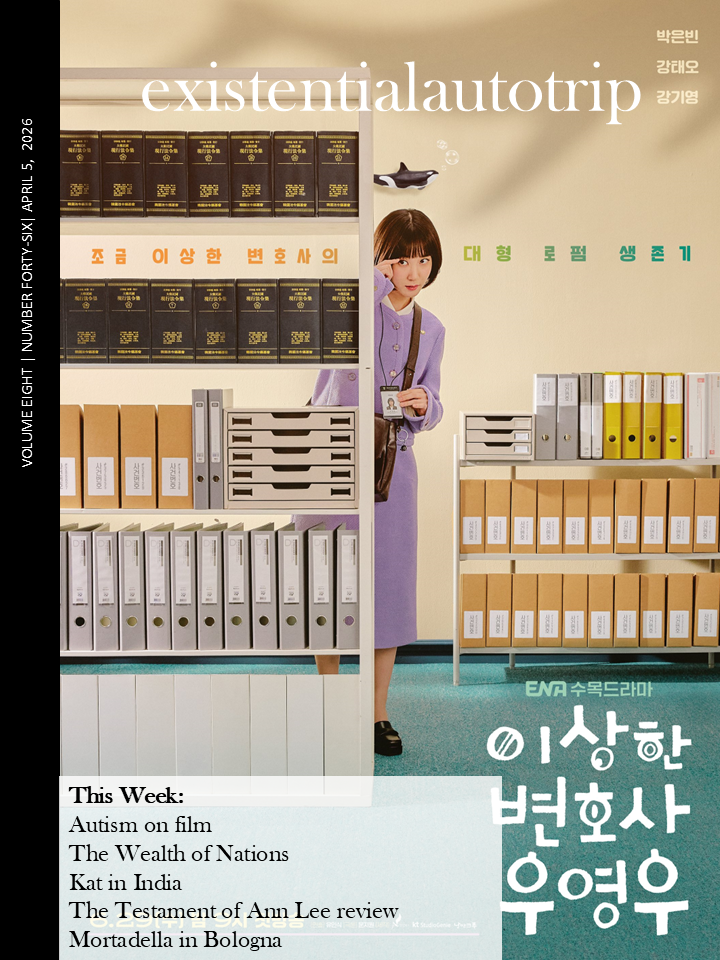
Tucker’s April 5, 2026 cover
# 1758
___________________________________
Thoughts from Dom’s Porch: Cover Story
Dom Capossela with AI
Film taking autism beyond the metaphor.
Film has often flattened autistic people, portraying them as symbols: the savant, the burden, the puzzle to be solved.
But in recent years, films have come to offer stories that treat autistic characters not as spectacles, but as people with interiority, humor, agency, and texture.
They don’t demand genius, nor do they collapse into tragedy.
Instead, they offer something closer to lived reality: unevenness, clarity, sensory logic, and the quiet dignity of someone navigating a world not built for them.
Series like Extraordinary Attorney Woo show how specificity becomes universality. Woo Young‑woo’s routines, her precision, her delight in patterns — these aren’t quirks for comic effect, but expressions of a mind working beautifully on its own terms. Other works follow suit: characters who love, work, struggle, and grow without being reduced to diagnoses.
What these stories share is that they let autistic characters be the center of their own narratives, not footnotes in someone else’s emotional journey.
Films & Series
I asked AI to order autism‑related films and series by how well they handle autism.
These films treat autism with nuance and warmth.
They are humane and grounded, not sentimental, not sensational.
⭐ 1. Extraordinary Attorney Woo
Why #1: The gold standard for respectful, character‑first portrayal. Woo Young‑woo is fully dimensional: brilliant, awkward, funny, principled, and deeply human. The show avoids both tragedy and miracle narratives. It’s warm, textured, and emotionally safe.
⭐ 2. A Kind of Spark
Why #2: Gentle, affirming, and made with autistic actors and writers. It’s aimed at younger audiences but never condescends. It treats neurodiversity as identity, not plot device.
⭐ 3. Everything’s Gonna Be Okay
Why #3: A queer, tender dramedy that treats autism as part of the family ecosystem. The autistic characters are played by autistic actors, and the tone is soft, funny, and real.
⭐ 4. Keep the Change
Why #4: Indie romance starring autistic actors. Naturalistic, unsentimental, and quietly radical in its normalcy. A small film with a big heart.
⭐ 5. The A Word
Why #5: A family drama that avoids melodrama. Shows how autism affects a whole system without turning the autistic child into a symbol. Sometimes heavier, but still humane.
⭐ 6. Please Stand By
Why #6: A sweet, respectful road‑movie about independence. Softer and more conventional than the others, but still avoids caricature.
⭐ 7. Life, Animated (Documentary)
Why #7: Beautiful and moving, but more emotional than the others. Still respectful, but slightly more sentimental — which is why it ranks lower in our zine list.
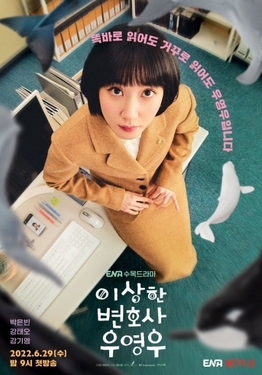
Extraordinary Attorney Woo is a 2022 South Korean television series starring Park Eun-bin in the title role, along with Kang Tae-oh and Kang Ki-young. It follows Woo Young-woo, an autistic female rookie attorney hired by a major law firm in Seoul. Because she is different from her neurotypical peers, her manner of communication is seen by them as odd, awkward, and blunt. With each legal case and through her intelligence and photographic memory, she becomes an increasingly competent attorney and earns recognition from other legal professionals and appreciation from her clients.
Extraordinary Attorney Woo set the record for the highest ratings in ENA history. It received audience acclaim, with its final episode recording 17.5% nationwide ratings, making it the eighth highest-rated drama in Korean cable television history and seventh highest-rated television drama by number of viewers.
________________________________
Thoughts from Dom’s Porch
Dom Capossela with AI
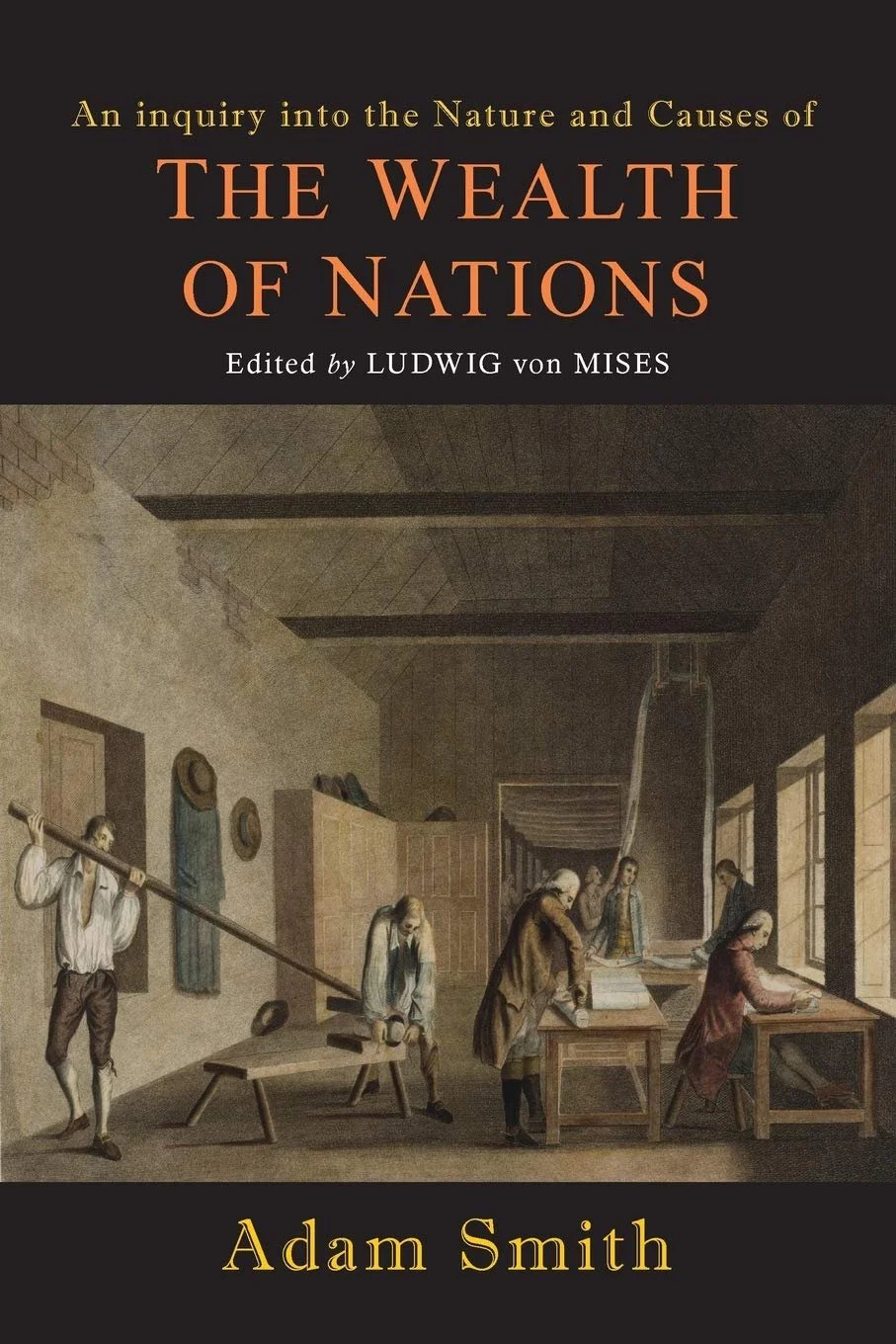
An Inquiry into the Nature and Causes of the Wealth of Nations, usually referred to by its shortened title The Wealth of Nations, is a book by Scottish economist and philosopher Adam Smith. Published on 9 March 1776, it offers one of the first accounts of what builds nations' wealth. It has become a fundamental work in classical economics, and been described as "the first formulation of a comprehensive system of political economy". Reflecting upon economics at the beginning of the Industrial Revolution, Smith introduced key concepts such as the division of labour, productivity, free markets and the role prices play in resource allocation.
___________________
Kat’s Gen Z Corner
Photo: use for kat india
______________
Tucker’s Corner
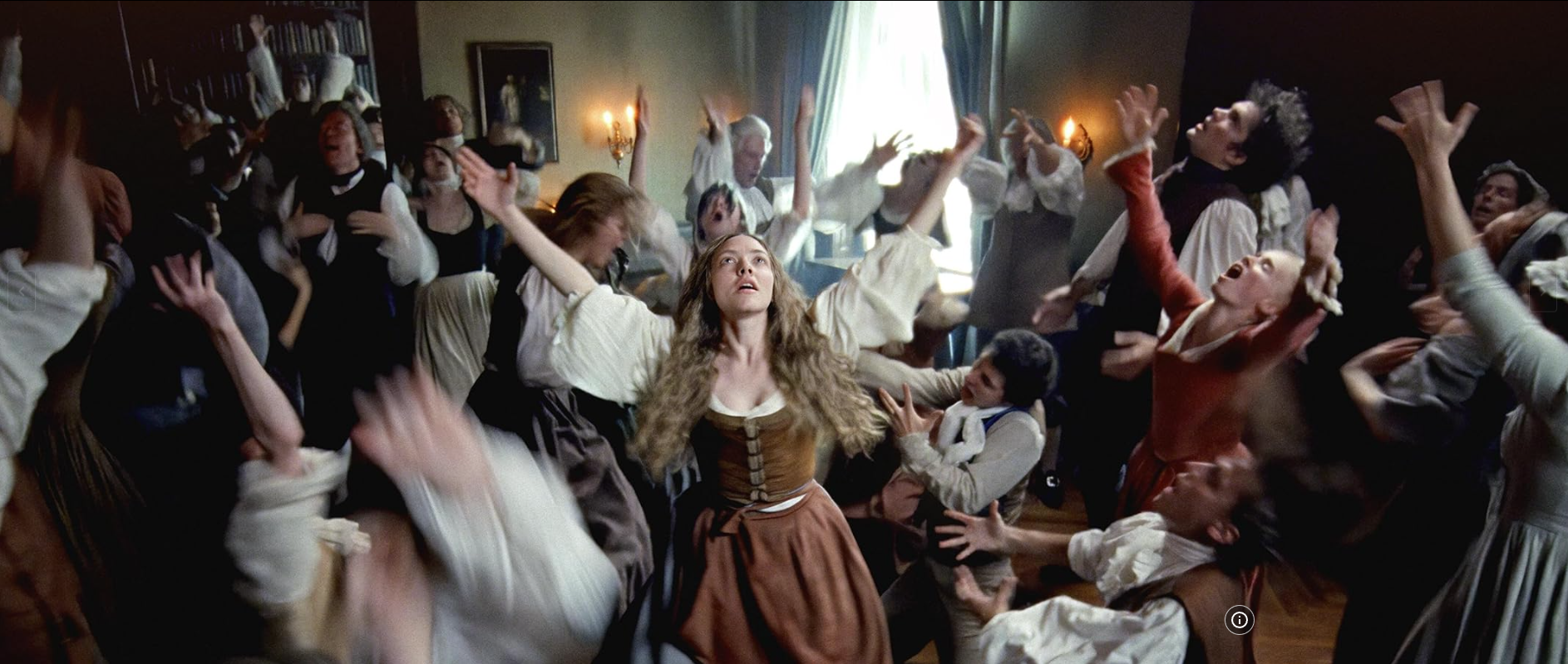
The Testament of Ann Lee
Sure to go down in history as one of the strangest musicals ever made, Mona Fastvold’s The Testament of Ann Lee tells the story of the founding leader of the Shaker faith through reimagined spirituals and hybrid dance sequences mixing traditional and modern moves. That might sound vaguely experimental and abstract, but the film is the opposite of aloof — it seeks to stir us, to immerse us in the sensibility of its distant era. Handsomely produced and shot on 70-mm., this film lovingly re-creates its 18th-century milieu in attitude; it throws us into this world and mind-set. And the bizarre song and dance numbers, for all their anachronism, pull us in further. It’s like The Witch meets Andrei Rublev meets “Rhythm Nation.”
Despite the artifice and irony, this is also an earthy film, filled with mud and blood and flesh. Ann Lee’s impoverished childhood in Manchester is spent dreaming of service to God while feeling revulsion at the physical facts of life. Having spied her parents having sex one night, she confronts her father the next day: “I know what you do to her,” she says, hatred and shame in her eyes. Even from a young age, Ann seeks transcendence, and Fastvold conveys both the dark crowded muck of poverty and the young girl’s airy dreams of light and love. “She yearned to find purpose amidst the dullness of her lot,” the narration informs us.
As a grown-up, Ann is played by Amanda Seyfried, who gives this young woman an anxious curiosity: She clearly craves something from the world, but she’s also terrified of it. It’s a great role for the actress, who tends to shine when she does more perverse parts. History doesn’t know much about Ann — as we learn, she was illiterate all her life, a fact she hides from her followers — and the script doesn’t attempt much specificity. This can leave a certain blankness at the film’s center, but Seyfried’s performance ably fills in the emotional details. Her Ann is physical and hungry but also contained and intense; we might not know her, but we understand her.
Although she is reluctantly married off to a handsome blacksmith named Abraham Standerin (Christopher Abbott), Ann recoils at the idea of sex. But she doesn’t have much choice, and after four agonizing childbirths and four agonizing child deaths (none of her offspring made it past one year), all depicted during one of the film’s saddest and most searing musical numbers, her life is transformed by grief, determination, and a little madness. Her subsequent founding of a Christian sect that renounces sex thus becomes not just an expression of extreme piety during a period steeped in religious revival, but also an unwitting attempt to cope psychologically with her pain. She will become Mother Ann, “mother to us all.”
I’m making this film sound bleak, and in some senses it is, but it’s also glorious. First, Ann discovers the “Shaking Quakers,” founded by Jane and James Wardley (Stacy Martin and Scott Handy), with their flailing, stomping dances. Later, as she sets out with her own flock for the American continent, the numbers become not just scenes of communion but abstract assertions of desire, with a choreography that mixes sinewy modern moves with the circular and regimented patterns of traditional dances. The music, much of it consisting of Shaker spirituals rearranged by Daniel Blumberg (who won an Oscar for last year’s The Brutalist, directed by Fastvold’s husband and co-writer Brady Corbet), is lyrical, emotional, sometimes even angry.
Fastvold doesn’t directly explore the theological dimensions of Ann’s faith aside from depicting her clear-eyed dedication to it. But she does suggest, through her choreography, that what was meant to be a purification ritual was, indeed, something of an indulgence. Along the way, romantic love and personal affection are denied and families torn apart. Ann’s loyal brother William (Lewis Pullman) must swear off his own lover, a man. Each refusal feeds the dance, giving it a tragic dimension. Swirling and reaching into the sky, the Shakers sought to expunge their sins and find communion with God, but what is the difference between exorcism and excitation? As if to illustrate that idea, the performers are simultaneously controlled and wild: Individual moves feel unhinged, but they fit into a whole, shaping unity out of chaos. The effect is that of passions diverted, of dark energies coalescing into something resembling a community. I’ve never quite seen anything like it.
There are, the film informs us at the end, two Shakers who are still around; at its height, the congregation numbered about 6,000. (Denying the act of procreation will obviously do that to you.) But Fastvold finds much to admire about the faithful as well. A church led by a woman in the 18th century was not just progressive, it was witchcraft to many, especially since the Shakers preached that Christ would return to Earth as a woman. Arriving in America, Ann and her followers are outraged by their first sight of a slave auction. Their pacifism later brings them in direct conflict with the colonists gearing up to fight the British. Fastvold emphasizes the collective side of the Shakers, their belief in equality and humility, as well as the beauty they found in the utilitarian. (Yes, we do get shots of all their awesome wooden furniture.) Ultimately, the director leaves us with more questions than answers. Which is probably what art should always strive to do.
_________________________
Chuckles and Thoughts

___________________________
Lisa’s Neck of the Woods
In the land of Bologna, Mortadella is king!
We’re in Italy and as you know, all roads lead to Rome. But did you know that in Bologna, all roads lead to mortadella? I have never seen a sandwich meat elevated to a god-like adoration and devotion, but here in Bologna, mortadella rules over the city and its food culture. They don’t call the place La Grassa for nothing! Not only can you find it in a sandwich, but it’s in everything else edible as well. The mortadella here is exquisite, light and velvety, and I find myself never getting tired of eating it 50 different ways. There are so many other fantastic dishes that you can eat here, but if you want to live like a local, you need to eat mortadella at least once a day in some form or you will be expelled from the city walls.
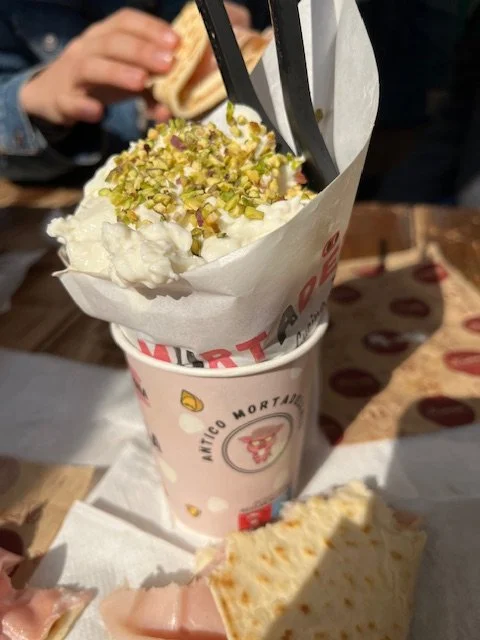
Fried mortadella cone
One of the first meals we set out to try once we arrived in Bologna was a sandwich from Mo Mortadella Lab. It is a take out (or as they say in Italy, a take away) street food shop in town that only serves mortadella sandwiches. You can order mortadella with stracciatella, burrata, parmigiano, eggplant, broccoli rabe, squacquerone, zucchini, and endless other additions. The bread is homemade and warm, and the most expensive sandwich is 7.5E. Holy cold cuts… this is ecstasy. People line up to buy one, and then take their culinary treasure to the nearest building wall and eat it standing up, or while sitting on a curb. Street food is a thing here in Bologna, and everyone walks or stands in the street while eating some sort of sandwich or arancina or gelato while on the move. And everyone is thin.
A variation of the standard sandwich is the piadina, which uses a thinner, tortilla like flatbread. Of course, it is filled with mortadella, or prosciutto, and pistachio cream is a common ingredient as well. Not feeling like an entire sandwich? How about the Italian version of a slider with tigelle bread, mortadella and an assortment of local cheeses? The tigelle is an awesome Modena tiny round English muffin type bread that is traditionally eaten with a pork cheek lard spread but also is perfect for a smaller taste of cold cuts.
I can’t forget the famous Florentine import that has enhanced the Bologna mortadella culinary scene. The All’ Antico Vinaio focaccia sandwiches have arrived here and the casual restaurant is quite popular with the local college students. The prices are a lot cheaper than the sandwiches in the US, so it’s an affordable option here.
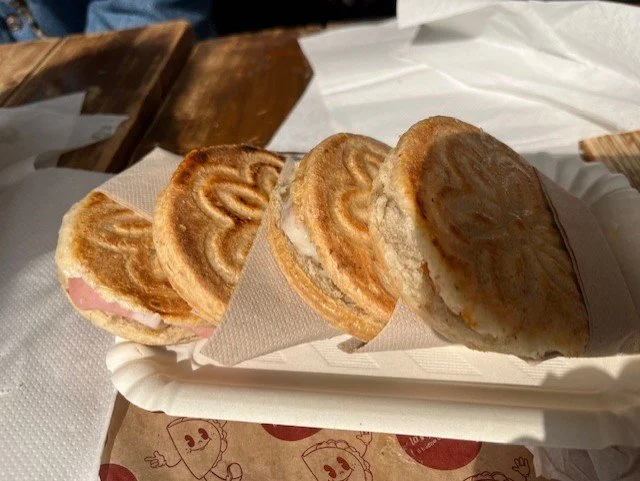
Mo Mortadella with our daughters
Tired of bread (is this possible)? How about mortadella bites fried and placed in a paper cone covered in stracciatella cheese and sprinkled with pistachio crumbs? Sounds weird but it’s delish. Coincidentally, the lunch take aways where you can sample the piadina, tigelle and fried mortadella versions are conveniently located next door to each other to optimize your mortadella intake in one fell swoop! If you partake of all 3 at one lunch, the city issues you credits for the next 2 days to meet your daily mortadella minimums.
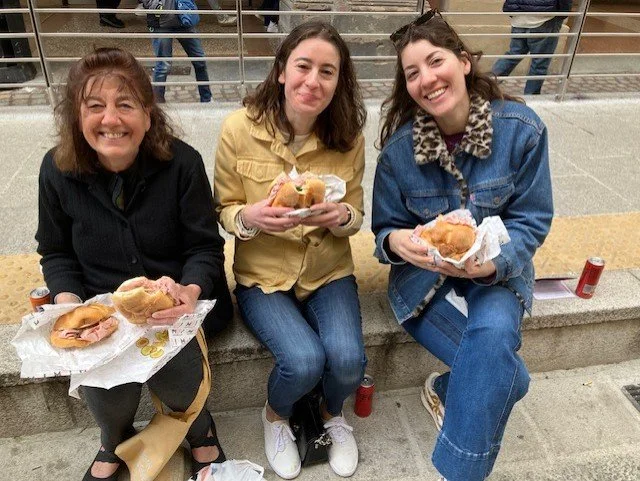
Mo Mortadella with our daughters
Let’s not forget pasta. There is a local pasta dish called Balanzoni which are large spinach tortellini type pasta filled with ricotta, spinach, cheese, and chopped …… drum roll please, mortadella! It’s served with a butter and sage sauce. Mamma Mia, it is perfecto!
I’m certain that there are mortadella desserts that we haven’t tried yet, but we have another week to find them. We’ll be sure to ask around when we return to all of the above places for our last fix of mortadella. When we arrive back in the States, mortadella is banished from our sandwich meat menu; we will have to go cold turkey!!!
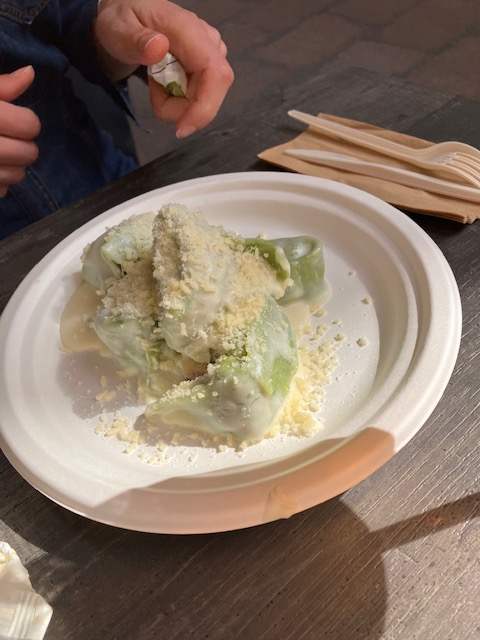
Balanzoni ecstasy!
____________________
Six Word Stories
Letter returned unread; heart didn’t.
The author is drawing a contrast between what the world does and what the heart does.
The letter comes back unopened — a physical sign of rejection, distance, or finality.
But the heart refuses to follow that logic.
It stays open, receptive, still feeling, still attached.
The world says: This connection is over. The heart says: Not for me.
So the meaning is that even when communication is cut off, the emotional bond remains.
The other person may have closed the door, but the speaker’s feelings haven’t.
Practical reality ends the exchange; the inner life keeps it alive.
It’s a line about unreturned affection, unfinished attachment, and that quiet ache of loving someone who no longer participates in the conversation — but whose presence hasn’t dimmed inside you.
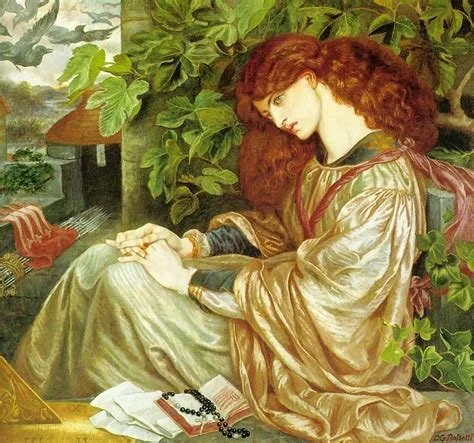
Pia de' Tolomei (1868–1880), Spencer Museum of Art, University of Kansas, Lawrence (model: Jane Morris)
Dante Gabriel Rossetti - Spencer Museum of Art, University of Kansas, Lawrence, KS, USA
Pia de' Tolomei is an oil painting on canvas by English artist Dante Gabriel Rossetti, painted around 1868 and now in the Spencer Museum of Art, on the campus of the University of Kansas in Lawrence, Kansas.
The work was painted at the start of Rossetti's affair with Jane Morris, who modelled for the picture. As he was to do with Beata Beatrix (1870), Rossetti chose a tale by Dante Aligheri (from Purgatorio) to illustrate his love for his model. The story tells of a woman whose husband imprisoned and later poisoned her: Rossetti wanted the world to believe the fantasy with which he was deluding himself – that William Morris kept Jane against her will. He continued this theme, as shown in Proserpine.
_____________________
Last Comment
We may get some additional cold days yet, but it’s safe to assume that winter has relinquished its grip.
Weather for the next three seasons should be reasonable.
And our local sports teams are looking good.
In the coming months we should get to enjoy many an exciting sporting event.

JT plays his heart out
!!!!!!!!!!!!!!!!!!!!!!!!!!!!!!!!!!!!!!!!!!!!!!!!!!!!!!!!!!!!!!!!!!!!!!!!!!!!!!!!!!!!!!!!!!!!!!!!!!!!!!!!!!!!!!!!!!!!!!!!!!!!!!!!!!!!!!!!!!!!!!!!!!!!!!!!!!!!!!!!!!!!!!!!!!!!!!!!!!!!!!!!!!!!!!!!!!!!!!!!!!!!!!!!!!!!!!!!!!!!!!!!!!!!!!!!!!!!!!!!!!!!!!!!!!!!!!!!!!!!!!!!!!!!!!!!!!!!!!!!!!!!!!!!!!!!!!!!!!!!!!!!!!!!!!!!!!!!!!!!!!!!!!!!!!!!!!!!!!!!!!!!!!!!!!!!!!!!!!!!!!!!!!!!